Somewhere Past Crewe: Notes on Writing Songs at Ninety Miles an Hour
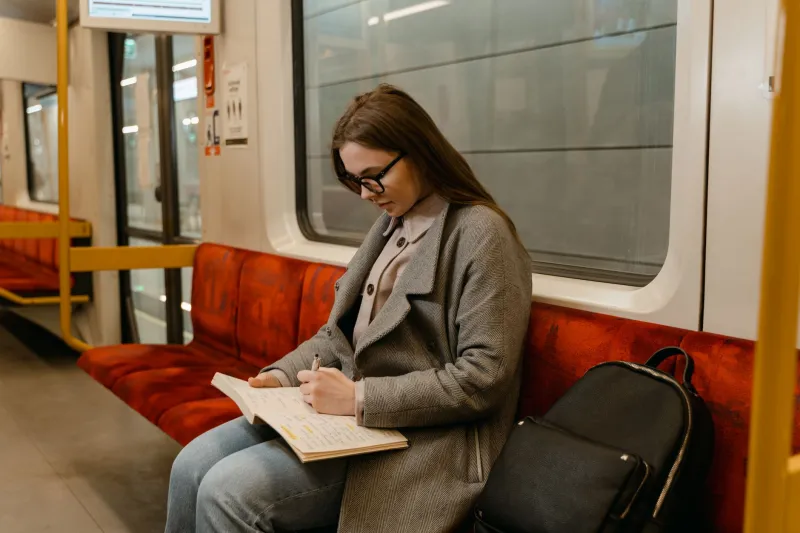
The 07:42 out of Birmingham New Street is never quite the train I booked. I book the quiet coach; I get the one where a man is conducting a business call in the vestibule like a vicar with a grudge. I book a table seat; I get the airline seat with the window that won't quite line up with my knees. And yet, four hours later, somewhere past Crewe, I'll have a verse I didn't have at New Street. That's the trade. You give up legroom and get a page.
This autumn's gig run has been stitched together almost entirely by rail — a handful of rooms in the Midlands, a couple of northern dates, a long haul up to Scotland and back down again. Twenty-two journeys and counting since September. It's not glamorous. It is, unexpectedly, the best writing desk I own.
The seat does half the work
There's something about a window seat that loosens the grip on a lyric. At home, the desk is where I go to finish things — the lamp is on, the tea is going cold, the song is expected. On a train, nothing is expected of me for four hours. That's the whole difference. Nobody is waiting for a chorus at Wilmslow.
I've started treating the window seat as a room with a very specific rule: nothing has to be good. The notebook gets whatever shows up. Jotted fragments. A rhyme that doesn't work yet. The phrase 'a coat with the wrong shoulders' which may or may not turn into something by spring. A train is a place where you can be bad at writing for a while, and nobody minds, because the person opposite is doing a sudoku and the person behind is asleep in a way that suggests they've made peace with the world.
The motion helps, too. There's a rhythm to a Voyager that gets into your pen. Not a steady beat — more a shuffle, a sway, a slight pause when the wheels hit a joint. I've written more half-decent mid-tempo songs on CrossCountry services than I care to admit, and I'm fairly sure the reason is that the songs were already going at that speed when I found them.
What the carriage says when it thinks nobody's listening
Trains are the last public rooms where people talk as if they're alone. Or rather, they talk as if the four rows around them are furniture. You learn things.
I once heard a woman two seats back tell her sister, quite calmly, that she was going to leave her job and open a bakery in Whitley Bay. I don't know if she did. I hope she did. The line — 'I've done the sums, and the sums say I'm allowed' — has been sitting in my notebook since 2024, waiting for a song with enough nerve to use it.
This is where the idea of borrowed speech comes in, and where I've learned to be careful. You take the cadence, not the confession. You take the rhythm of how someone says a thing, the way they pause before the word that costs them something. You leave the actual life alone. A notebook full of other people's business isn't folk music; it's just nosiness with a guitar. So I write the shape of it, not the detail, and I try to change enough that if the woman from Whitley Bay ever heard it, she'd recognise the feeling and not herself.
The delay is part of the song
There is no honest tour diary without the words 'signal failure at Stafford'. This autumn I lost an hour and a half outside Nuneaton and wrote what is possibly the best bridge on the record. I'm not recommending delays. I am saying that the timetable already edits the setlist, so you might as well let it edit the notebook too.
When a train stops in a field and the tannoy says nothing for eleven minutes, something in the brain relaxes. You stop trying to arrive. You start noticing. The way a hedge goes by in a smear, then slows, then sharpens into individual twigs. The way the light changes over the Peak District between one station and the next. The way a song that felt too obvious in the kitchen can feel honest again when you're stuck near Tamworth with a cold coffee.
I've stopped fighting it. If the journey goes wrong, the notebook gets a page about the wrongness. That's still a page.
Five prompts for a moving notebook
These are the ones I actually use. They take about ten minutes each, which is roughly the gap between stops on a decent run.
- Write the last thing you overheard, verbatim. Then write, underneath, what you think the person was actually afraid of. Don't use either in a song. Just notice how the two sit next to each other.
- Describe the view in five nouns and one verb. No adjectives. A field, a pylon, a river, a cottage, a sheep; leaning. It's a strangely good exercise for choruses.
- Take a station name and make it a title. Not a joke — a real title. What kind of song is called 'Stockport, Sunday'? What is the first line?
- Set a timer to the next stop. Write until the tannoy interrupts. Whatever you have when the brakes go on is the draft. It's almost always more than you think.
- List what you'd leave on the train if you had to. This one is less about writing and more about the year. It's surprising what comes up between Doncaster and York.
Arriving with something
The thing nobody tells you about writing on the move is that the song doesn't need to be finished when you step onto the platform. It needs to be started. A gig is much easier to play when you walk in with a page you didn't have at the start of the journey — even a bad page, even a page with three good words and a lot of scribble.
So this is my small argument for the window seat. Not because trains are romantic — they're mostly a trolley, a bin bag, and a person eating crisps with real commitment — but because four hours of being nowhere in particular is the closest thing to a writing room that most of us can afford. Take the notebook. Take the pen that doesn't leak. Take the delay as a gift, or at least as a prompt.
And if you see me on the 07:42, head down, mouthing something at the glass — leave me be. I'm somewhere past Crewe, and I'm nearly at the chorus.