Cushion Height: What a Front Room Does to a Song
There is a particular sound a room makes when twenty people decide, more or less at once, that they are not going to applaud until the very end. It is not silence, exactly. It is the sound of people trying not to rattle a cup. I have spent a good chunk of this year playing in other people’s front rooms, and that sound has become the backing vocal I did not know I was listening for.
No Stage, No Hiding
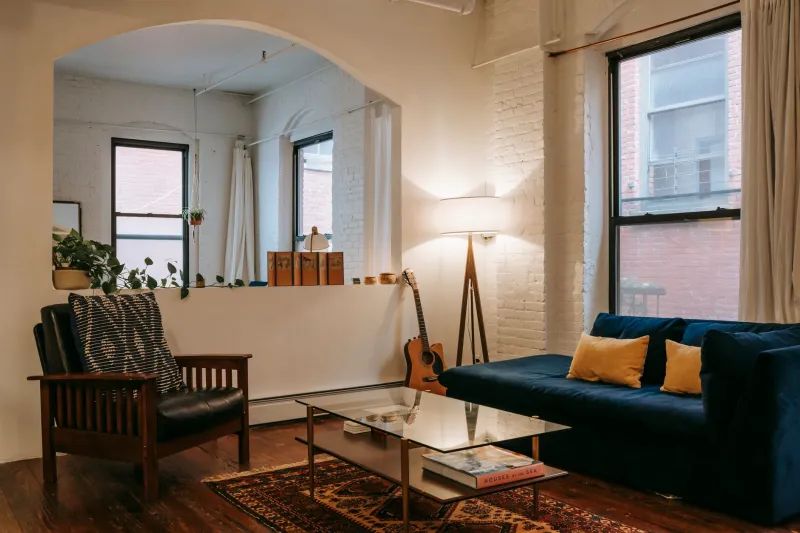
The first thing a living-room gig removes is the small lie of the stage. On a proper stage, even a low one in a village hall, there is a line between the performer and the room. It is not a hostile line, but it is a line. You can put a foot over it. You can retreat behind it. In a lounge, with the sofa pushed against the wall and the coffee table relocated to the hallway, there is no line at all. There is a rug, a music stand, and a room full of people who can see your shoelaces.
That is not a complaint. It is a fact you have to work with. Without a stage, the songs have to carry themselves in a different way. You cannot lean on lighting or a bit of reverb to suggest intimacy; you are already intimate. The question becomes whether the song can survive being heard from three feet away. Some can. Some need a little more room than a semi-detached in Bristol can offer.
The Room Sets the Mix
In a venue, you get a soundcheck. In a front room, you get a survey. Where are the soft furnishings? Is there a piano nobody plays? Is the ceiling low enough that a strummed chord turns into a cloud? I have played rooms with wooden floors that made everything sound like a kitchen, and rooms with so many bookshelves that the guitar arrived back at my ear a half-beat late. You learn to listen to the room before you play to it.
The practical upshot is that the setlist changes. Songs with a lot of space in them — a single held note, a verse with almost nothing under it — tend to do well. Songs that rely on a big, washy strum can turn to mush. I have started carrying a smaller amp for these shows, not because I need volume, but because I need control. At close range, a little goes a long way. So does a biscuit.
A Shorter Setlist, a Longer Conversation
On a normal tour, the set is a shape: a beginning, a middle, an ending, maybe an encore if the room asks nicely. In a living room, the shape is more like a conversation. People ask questions between songs. Someone refills your glass. A dog investigates your pedalboard. You can either fight that or lean into it. I have learned to lean.
The setlist shrinks. Not because the audience is less attentive — if anything, they are more attentive — but because the gaps between songs start doing some of the work. A story that would feel like a delay in a 300-capacity room feels natural in a front room. You can say, “This one is about my grandmother’s kitchen,” and nobody is checking their watch. They are checking whether the kettle has boiled.
The Etiquette of Someone Else’s Carpet
There is a quiet code to these gigs. You do not put your glass on the floor without a coaster. You do not assume the loo is upstairs. You do not play a song about wanting to leave a party when you are sitting in a stranger’s lounge and they have made a quiche. Or you do, but you preface it.
The hosts are the unsung heroes of the whole thing. They have moved furniture, warned the neighbours, and worked out how to fit thirty people into a space designed for six. They have also taken a small risk: their home is now a venue, and their living room is the thing everyone will remember. I have played to people sitting on cushions, on beanbags, on the arm of a sofa, and once on a footstool that I was quietly afraid would not survive the second chorus. It did. The song did too.
What the Close-Up Reveals
When the audience is at carpet level, you notice things. You notice that the person in the corner knows every word but is mouthing them rather than singing. You notice the couple who hold hands during the sad one and pretend they are not. You notice the teenager who has been dragged along and is now, against their will, paying attention. You notice because you are close enough to notice.
That closeness is the whole point, and it is also the thing that makes it hard. There is nowhere to hide a lyric you are not sure about. There is no lighting cue to cover a fumbled chord. But there is also no barrier to the moment when a song lands. In a big room, you see the wave of reaction. In a front room, you see the face of one person who has just heard something they needed to hear. That is a different kind of reward, and it is worth the drive.
The Drive Home
After the last song, there is tea. There is usually cake. There is the slightly surreal experience of packing a guitar into a case while someone’s cat inspects the lid. Then there is the drive home, often down an A road with the radio off, replaying the bits that worked and the bits that did not.
The sofa tour has taught me that a song is not a fixed thing. It is a shape that changes with the room it is played in. Put it in a concert hall and it grows. Put it in a lounge and it shrinks to a size you can hold in your hands. Both are true. Both are the song. And if you are lucky, someone will offer you a second cup of tea before you go. You say yes. You always say yes.