The Loaner: What Someone Else’s Guitar Tells You About Your Own Playing
There is a particular moment, about forty minutes before doors, when someone says: ‘Don’t worry, we’ve got a guitar you can use.’ It is always said kindly. It is almost always followed by a sound from a cupboard.
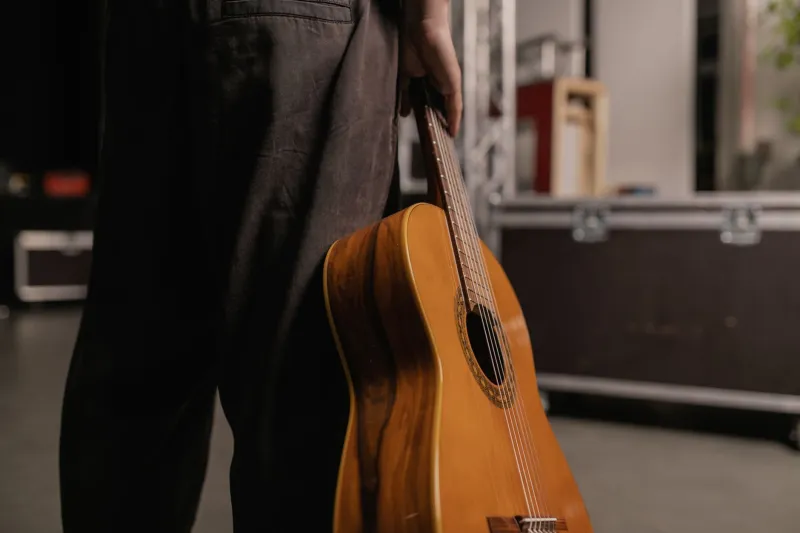
The guitar emerges. It has been in that cupboard since the last time someone needed it, which may have been a wedding, a wake, or a children’s nativity. The case has a smell of old carpet. The strings are either rusty or so new they are still stretching. The action is high enough to post a letter under. And the promoter, who has been generous and patient all afternoon, looks at you hopefully.
You say yes. Of course you say yes. You are playing a village hall in the middle of a long week, the train was delayed, and the alternative is a two-hour detour to fetch your own instrument. So you plug in, or don’t, and you begin the strange business of playing a guitar that does not know you.
The handshake before the soundcheck
A borrowed guitar is not simply a different instrument. It is a different set of assumptions. The neck is fatter or thinner, the scale length is shorter or longer, the fretboard radius makes barre chords feel like a rumour. The first chord you play — usually a G, because it is honest — tells you everything. The string tension is wrong. The tuning is precarious. The tone is a stranger with a firm handshake and no sense of humour.
At a cricket pavilion last summer, the house guitar had a pickup that hummed in E flat. At a working men’s club in the north, the loaner had a nut so worn that the low E sat practically on the first fret. In a church hall with excellent acoustics but terrible heating, the guitar had been stored next to a radiator and had developed a personality crisis in the lower bout. None of these were disasters. They were just reminders that the instrument in your hands is only half the performance.
The other half is the room. The loaner forces you to listen to it.
Action, relief and the truth about muscle memory
Most of what we call technique is really habit wearing a nice jacket. We know where the third fret is because our hand has been there ten thousand times. We know how hard to press because our fingertips have made a private peace with our own guitar’s action. Hand us something else and the peace breaks.
This is useful. It is uncomfortable, but it is useful.
On a guitar with high action, you cannot rely on speed. You have to mean every note. On a guitar with slipping tuners, you learn which chords you can cheat and which ones will expose you. On a guitar with a narrow neck, you discover that the voicings you love are not the only voicings available. The songs start to breathe differently because you are not playing them the way you always play them. You are playing them the way this guitar will allow.
I have written worse songs because I was too comfortable. I have rarely written a bad song because I had to work for it.
What the loaner hears that you don’t
There is a practical side to this, and it is worth saying plainly: a borrowed guitar will expose the parts of your set that depend on production rather than writing. If a song only works because of a particular pedal, a particular pickup, a particular compression, it will feel thin on a loaner. If a song works with six strings and a room, it will survive almost anything.
That is not an argument against gear. I love gear. I have a pedalboard that has its own postcode. But the loaner is a good editor. It asks: which bits of this arrangement are actually the song? Which bits are just the way you have become used to hearing yourself?
At a support slot in Leeds earlier this year, I played a borrowed guitar with a neck like a fence post and a pickup that sounded like a wasp in a jar. The song I had been worried about — a quiet one, mostly fingerpicked — came alive because I had to slow down. The song I had assumed was a banker — a strummy, mid-tempo thing — fell flat because I could not hide behind the usual chime. The room did not notice. The room never notices. But I noticed, and that is the point.
A small case for making do
There is a romance to the right instrument. The guitar that fits your hand, the amp that does the thing, the pedal that makes the room feel like a room. I am not against any of it. But the village hall circuit is not a studio. It is a series of small, improvised agreements between people who want a song to happen.
Making do is part of the job. The caretaker with the keys, the tea urn that takes twenty minutes to boil, the stage made of pallets, the borrowed guitar with the action of a footbridge. These are not obstacles to the performance. They are the performance, or at least the texture of it.
And there is a strange freedom in playing an instrument that owes you nothing. It does not know your history. It does not care about your usual tone. It is not impressed by your muscle memory. It just wants to be played, and it will tell you immediately whether you are listening.
The return
At the end of the night, you hand it back. You thank the promoter. You put the case in the cupboard, or behind the bar, or in the boot of someone’s car. You might never see it again.
But you take something with you. A new way of holding a chord. A song that needed slowing down. A reminder that the instrument is not the performance, and that the room is always part of the band.
Next time, you might bring your own guitar. You probably will. But you will also glance at the cupboard and wonder what it would sound like tonight.