The Room Refills: Choosing Music for the Gap Between Sets
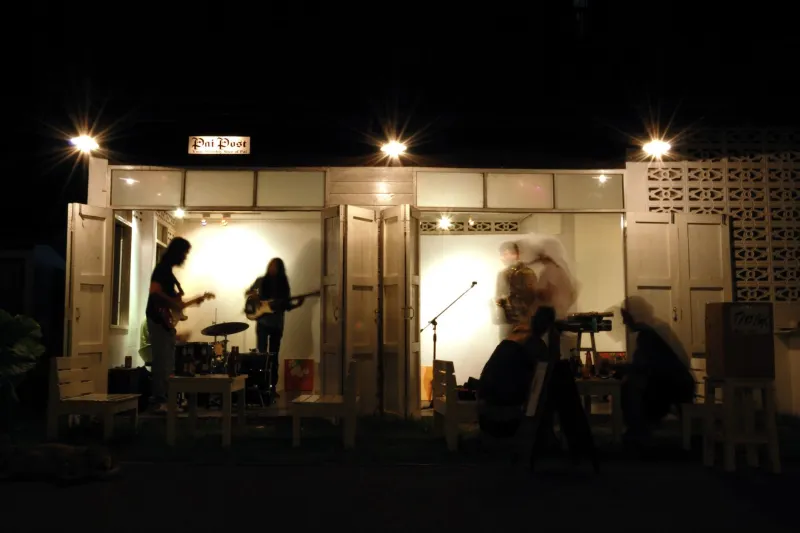
There’s a sound a small venue makes about ninety seconds after the last chord. It’s not silence. It’s chairs, a door, a till, someone laughing too loudly near the loos, and the low shuffle of people deciding whether they’re staying. I’ve come to think of that sound as part of the gig. And the music you put underneath it matters more than most people think.
The gap isn’t a void
When I first started playing village halls and back rooms, I treated the interval like a technical fault — something to be endured while I retuned and drank some water. I’d leave the PA on, put on whatever was in the van, and hope. Sometimes that meant a stray compilation CD from a motorway services, sometimes it meant nothing at all except the fridge humming.
Then a promoter in Sheffield said something that stuck: “The interval is where the room chooses you.” Half the audience is at the bar. Half is still in their seat, not quite ready to admit the first set is over. Your job is to make the second half feel like a continuation, not a restart.
Three rules I keep taped inside the flight case
One: never outshine the songs. Interval music is a host, not a headline. I want people talking, not turning to each other saying, “What’s this?” If the track is too good, too loud, or too strange, it pulls focus. Save the revelation for the set.
Two: match the room, not the playlist. A seated listening room in Bristol wants something different from a Friday pub in Leeds where the bar is doing most of the talking. I carry two short playlists on my phone: one low and warm, one brighter and more rhythmic. I pick in the moment, mostly by looking at shoes.
Three: leave a little air. I don’t want wall-to-wall sound. A few seconds of room noise between tracks is good. It lets the space breathe and stops the interval feeling like a corporate playlist on shuffle.
What I actually play
My default is instrumental, mid-tempo, and slightly familiar without being a singalong. I avoid anything with a huge vocal hook, anything that could be mistaken for a cue, and anything I’d be embarrassed to have on a royalties spreadsheet. Here’s a sample twelve-track interval sequence I’ve used this year in small rooms — the kind of thing that fills the gap without taking over.
- A low, brushed-drum jazz piece — something like a late-night café soundtrack
- A fingerpicked acoustic instrumental from a UK folk label
- A soft ambient piano track with no discernible melody
- A dubby, bass-light reggae instrumental
- A slow, wordless post-rock piece (kept very quiet)
- A vintage soul instrumental with horns, low in the mix
- A minimal electronic track with a steady, unremarkable pulse
- A cello-and-harmonium drone from a contemporary classical album
- A gentle bossa nova guitar piece
- A film-score cue with strings and no crescendo
- A lo-fi beat with the high end rolled off
- Something short and slightly odd to signal the return — a thirty-second field recording or a single piano note
The last one is the tell. When I want people back in, I don’t announce it. I let the music thin out, then stop. The silence after the final interval track is louder than any “we’ll be back in five minutes” announcement.
Licensing, volume, and the venue’s mood
I’m not a licensing expert, but I’ve learned to ask. Most small UK venues have some form of music licence — PRS for Music and PPL are the names you’ll hear — but what that covers can vary. If I’m playing my own interval playlist from a phone through the PA, I check with the promoter whether the venue’s licence covers recorded background music, and whether they want me to use a specific playlist or their own system. Some places have a house Spotify account and a strict “no phones near the desk” policy. Others hand you a jack cable and say, “Put something on, love.”
Volume is the other constraint. The interval is not the time to test the subs. I aim for a level where two people at the bar can order without leaning in, and someone in the front row can still hear their friend without raising their voice. If the room is small enough that the bar is the back wall, I sometimes turn the music off entirely for the first minute and let the room settle. That’s not laziness. It’s a reset.
Reading a half-divided room
UK crowds are polite in a very specific way. They won’t tell you the interval music is too loud. They’ll just drift. You can watch it happen: first the bar queue gets longer, then the seats near the door fill up, then someone checks their phone and the coat comes off the back of the chair. By the time you count back in, you’ve lost the edge of the room.
The trick is to give them a reason to come back before they’ve fully decided to leave. I like a track that’s warm enough to feel like company but unobtrusive enough that it doesn’t compete with conversation. If the room is quiet and attentive, I’ll go sparser — a single instrument, lots of space. If it’s a chatty pub, I’ll go slightly more rhythmic, just to give the chatter a floor. I don’t try to beat the bar. I just try to keep the door open.
The return is the whole point
I used to think the interval was the least creative part of the night. Now I think it’s one of the most honest. It’s where you find out whether the first set landed, and it’s where you decide what kind of second set you’re going to play. The music between the songs is part of the set, even if it’s not yours.
So I keep the playlist short, the volume low, and the last track almost silent. Then I plug in, say thank you for staying, and start again. The room refills. That’s the job.